After the trial
Free
€0forever
- Up to 300 business listings from maps (POI) per month
- Basic table and CSV export
- For small one-off checks

Browser extension · Google Maps
Collect publicly visible Google Maps business listings into a structured table. See which fields come from the map, what company websites can add and which gaps Yandex Maps or 2GIS may fill.
7-day free trial: collect up to 1,000 business listings from maps (POI) for new accounts after email sign-in. No payment card is needed for the trial.
| Name | Category | Rating | Reviews | Status |
|---|---|---|---|---|
| North Coffee | Coffee shop | 4.8 | 126 | Open |
| Line Workshop | Repairs | 4.6 | 84 | Open |
| Nearby Pharmacy | Pharmacy | 4.7 | 209 | Open 24 hours |
Straightforward pricing
Test the output on your own searches first. Then stay on Free, get a Day Pass or choose a monthly volume.
After the trial
€0forever
One-off task
€9one-time
Regular collection
€19per month
About formats: XLSX and Google Sheets are available during the trial, with a Day Pass and on the Data plan. The permanent Free plan exports a basic CSV table. All plans and limits →
Three steps to a table
Search for a category, business or place in the country and city you need.
The extension reads publicly visible listings from the open tab.
Review rows, sources and field coverage before exporting the result.
Interface and output
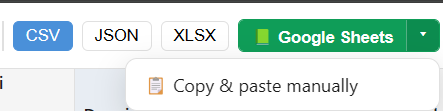
Actual extension screenshots: the populated table and the export menu.
Catalogue verified 2026-08-21: 22 native field positions and up to 53 normalized map columns. Website enrichment is counted separately.
Decision guide
Start with the source that best matches your market and required fields. Use another map only for the gaps that matter.
Google Maps supports a consistent research workflow across countries, especially for chains, travel and international services.
Listing and attribute availability varies by country, category and individual business. The page does not promise identical coverage for every row.
Current Google Maps Platform coverage table · 2026-08-25 ↗Use one discovery workflow to compare local markets, cities and chains across borders.
Research hotels, restaurants, attractions and services with ratings, hours and service attributes.
Collect brand locations across cities and preserve Place IDs and coordinates for repeatable analysis.
Stable identifiers and geographic fields make locations easier to verify and match.
Parking, payment methods, accessibility and other signals support service-level segmentation.
Visible busyness and hours add context for demand research and follow-up checks.
Place types are useful when normalising and comparing international datasets.
A listing may omit a website, phone, menu, popular times or individual amenities.
A price level is not a monetary amount; Yandex Maps can add more local price context.
Nearby transit, products, jobs and building details are often better covered by Yandex Maps or 2GIS.
Four data layers
Map collection, website enrichment and calculated estimates answer different questions. CrawlRover keeps those layers conceptually separate.
22 field positions and up to 53 normalized columns from public map listings.
CMS, analytics, chats, booking, payment, domain and infrastructure signatures when a company website is known.
Digital maturity, website health and growth signals derived from available observations. These are estimates, not company-declared facts.
Selected gaps can be filled from the other supported maps when the same company can be matched with enough confidence.
Native map fields
22 field positions can expand into up to 53 normalized columns. A position is a business concept; columns are its separate exported values.
Verified catalogue: 2026-08-21. Filled fields depend on the public listing and collection scenario. Compare all five maps →
Website enrichment
When the listing contains a public website, CrawlRover can inspect observable HTML and infrastructure signatures and return them in separate enrichment fields.
A detected HTML signature indicates that characteristic code was observed during the scan. It does not prove that tracking, payment or a widget is configured correctly at runtime. Digital maturity, website health and growth indicators are calculated estimates and should be used for prioritization, not as verified company statements.
Questions and boundaries
Start with your own category and city, then export only after checking rows, sources and the fields that matter to your task.
Five-map workflow
Each map has a different mix of geography and fields. Open the provider page that can answer your missing question.